

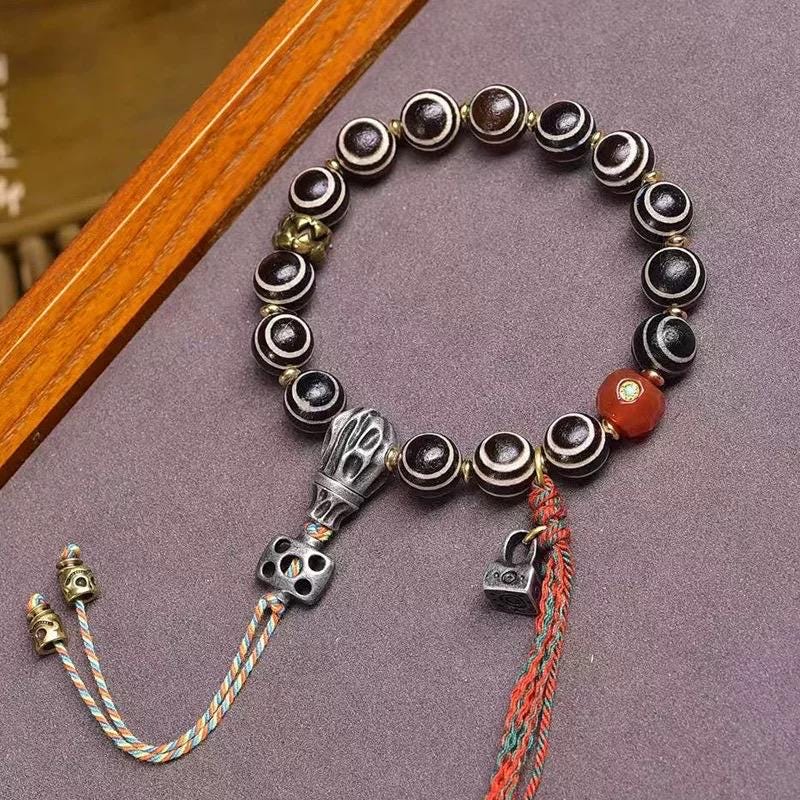
Agate is one of the most common stones in Tibetan-style bracelets and malas, yet the names around it can be confusing: red agate, black agate, onyx, chalcedony. This short guide explains how they relate, what to look for and how to choose a size.
Agate, chalcedony and onyx: how they relate
All three belong to the same family. Chalcedony is a fine-grained form of quartz. Agate is usually described as chalcedony that shows bands or layers, while the name chalcedony on its own is often used for the plainer, softly translucent stone. Onyx traditionally means chalcedony with straight, parallel bands; in today's jewelry trade, "black onyx" usually refers to evenly black agate beads.
Because they are forms of quartz, these stones are fairly hard (around 6.5 to 7 on the Mohs scale) and stand up well to everyday wear.
The colours you will see
Red agate
Warm red to orange agate has long been popular in Himalayan jewelry. Agate and the closely related carnelian also appear in some Buddhist lists of the "seven treasures", which is a common explanation for its place on malas and prayer bracelets.
Black agate and black onyx
Deep black and quietly glossy, black agate is often chosen for men's bracelets and for malas because it pairs easily with other stones such as tiger eye.
Dzi-patterned agate
Traditional Tibetan dzi beads are agate decorated with eyes and lines. If the pattern matters to you, our guide to dzi bead eye patterns explains the common designs.
Chalcedony
Plain chalcedony tends toward milky, pastel or softly glowing tones. It suits people who prefer a gentle look over strong banding.
Agate Bracelets and Malas
Red, black and dzi-patterned agate pieces from our Agate collection.


Natural colour, dyed or heat-treated
A great deal of agate on the market is dyed or heated to deepen its colour. This is a long-standing and widely accepted practice, especially for evenly black beads and very vivid reds. A few signs can help:
- Perfectly even colour with no banding at all often points to dye.
- Colour that gathers in cracks or around the drill holes is another hint.
- Natural agate usually shows faint bands or cloudiness when held up to a light.
If natural colour matters to you, read the product description closely or ask the seller before buying.
Choosing bead size and fit
- 6 mm (0.24 in): light and fine; common on 108-bead malas that wrap around the wrist.
- 8 mm (0.31 in): a balanced everyday size.
- 10 mm (0.39 in): bolder, often preferred for men's bracelets.
For a single-strand bracelet, measure your wrist and add about 1 to 2 cm (0.4 to 0.8 in); larger beads need the upper end of that range. Our bracelet size guide walks through measuring step by step.
Caring for agate
- Wipe with a soft, dry cloth after wearing.
- Take it off before showering, swimming or sleeping, and keep it away from perfume and cleaning products, which can dull the polish and weaken the cord.
- Roll elastic bracelets onto the wrist instead of stretching them.
- Store it on its own or in a pouch so harder stones and metal do not scratch it.
Whichever colour you choose, agate is a durable, easy-going stone that wears well every day and gains a soft sheen with time.


