

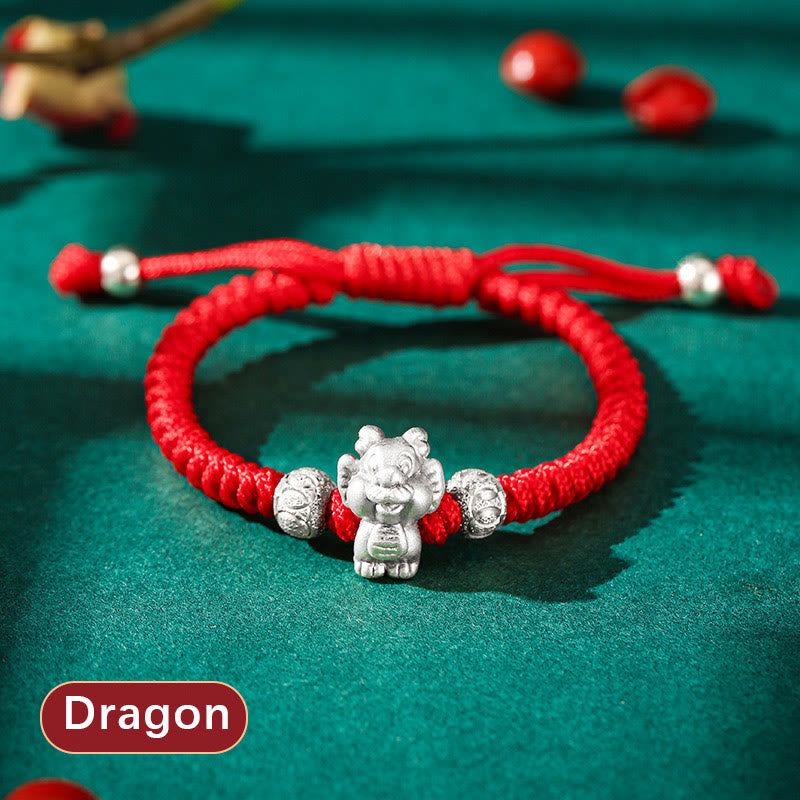
A braided red cord with a small silver charm is a traditional gift for a child in many Chinese and Tibetan Buddhist families, often given at a birthday, the New Year or a child's zodiac year. This guide covers what the knot is usually said to mean, how to get the size right, and the safety habits that matter most with young children.
What the knot and the red cord mean
Many of these bracelets are tied in a vajra knot (often sold as a "King Kong knot", from the Chinese name jingang jie). The common explanation is that the knot stands for protection and steadiness, and red cords are widely worn as a sign of blessing and good wishes. Multicoloured cords are usually linked to the five traditional Tibetan colours. These are meanings and customs, not promises of any effect; most families give them simply as a token of care.
Which design to choose
Chinese zodiac charm
A small silver animal for the child's birth year makes the gift personal. If you are unsure of the animal, our zodiac bracelet guide explains how to find it, including for birthdays in January or February.
Pi Xiu charm
Pi Xiu is a guardian creature from Chinese feng shui tradition, usually linked with good fortune. It is a common choice from grandparents. Read more in our Pi Xiu bracelet guide.
Plain knot
A knotted cord with only a small silver bead is the simplest and lightest option, and suits children who dislike anything dangling.
Children's bracelets in the shop
Handmade braided cords with sterling silver charms. See more in Red Protection String.


Getting the size right
Our children's bracelets are listed as 12 cm (4.7 in) plus a 4 cm (1.6 in) extension, so they adjust up to about 16 cm (6.3 in). Measure the child's wrist with a soft tape or a strip of paper just above the wrist bone. A good fit lets one adult finger slide under the cord: loose enough to be comfortable, but not so loose it slips over the hand. Children grow quickly, so start the bracelet near the shortest setting and let it out over time.
Safety habits
- Small charms and beads can be a choking hazard. Choose a cord bracelet only for a child old enough not to put things in their mouth, and check the knots and charm regularly.
- Take the bracelet off for sleep, swimming and rough play, so the cord cannot catch or tighten.
- For babies and toddlers, many families keep the bracelet as a keepsake, or tie it to a pram or cot out of reach, rather than putting it on the wrist.
Care
Keep the cord dry where possible so it holds its colour, and wipe the silver charm with a soft cloth. A cord that frays can be retired with respect and replaced; many families keep the silver charm.


