

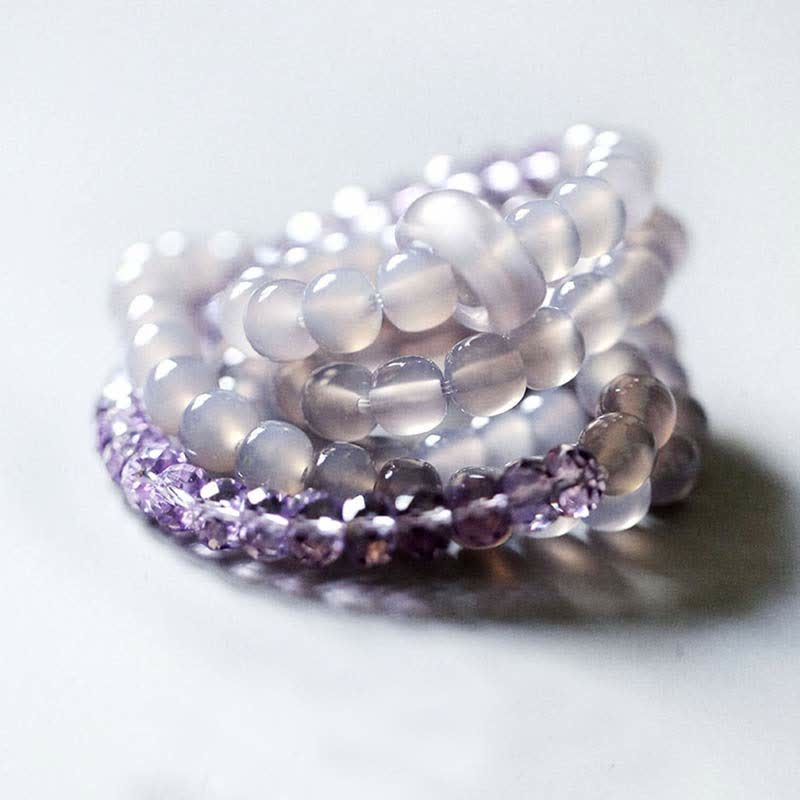
Amethyst is the purple stone most people picture when they think of a crystal bracelet. This guide explains what it is, how its colour varies, how natural stone differs from synthetic and glass, and how to choose and look after an amethyst bracelet or mala.
What amethyst is
Amethyst is the purple variety of quartz. The colour comes from traces of iron in the crystal together with natural irradiation in the ground. It sits at 7 on the Mohs hardness scale, so it is hard enough for daily wear and for beads that rub against each other.
Colour: pale lilac to deep purple
- Pale lilac: soft and light, sometimes sold as lavender amethyst. It looks gentle on the wrist and is usually the most affordable.
- Medium purple: the most common shade for bead bracelets, clear enough to let light through.
- Deep purple: a strong, saturated colour, sometimes with red or blue flashes. It is generally the most sought after.
Natural amethyst is rarely perfectly even. Lighter and darker zones inside a bead, and small differences from bead to bead, are normal.
What it is associated with
The name comes from a Greek word meaning "not intoxicated", and the ancient Greeks linked the stone with a clear head. It is also the traditional birthstone for February. In crystal traditions today amethyst is commonly described as a stone of calm and clarity, which is why it is popular for meditation beads. These are cultural associations, not tested effects. Many people simply choose it because the colour is quiet and steadying to look at.
Amethyst bracelets and rings
Bead bracelets and silver pieces from our Amethyst collection.


Natural, synthetic and glass
Synthetic amethyst is real quartz grown in a laboratory. It has the same hardness and chemistry as mined stone and cannot reliably be told apart by eye; that takes gemmological testing. As a rough guide, natural beads tend to show uneven colour and small internal marks, while a strand that is perfectly uniform and flawless at a very low price deserves a question to the seller.
Glass imitations are easier to spot. They often contain tiny round bubbles, feel warmer and lighter in the hand, and scratch more easily.
How to choose
Bead size
- 6 mm (0.24 in): light and discreet; good for slim wrists and for stacking.
- 8 mm (0.31 in): the usual choice, comfortable for most wrists and easy to count.
- 10 to 12 mm (0.39 to 0.47 in): bolder and heavier; the colour shows most clearly in larger beads.
For fit, see our bracelet size guide.
Bracelet, mala or ring
An elastic bead bracelet is the simplest piece for every day. A 108-bead mala suits mantra counting; if that is your purpose, read which mala length is right for you. A ring or pendant set in silver shows a single stone and keeps it away from knocks on the wrist.
Care
Amethyst can fade if it is left in strong sunlight for long periods, so do not store it on a windowsill. Keep it away from high heat, which can also change the colour. Wipe the beads with a soft dry cloth after wearing, and take the piece off before washing, swimming or sleeping so the cord lasts longer. For more detail, read how to care for mala beads.


