

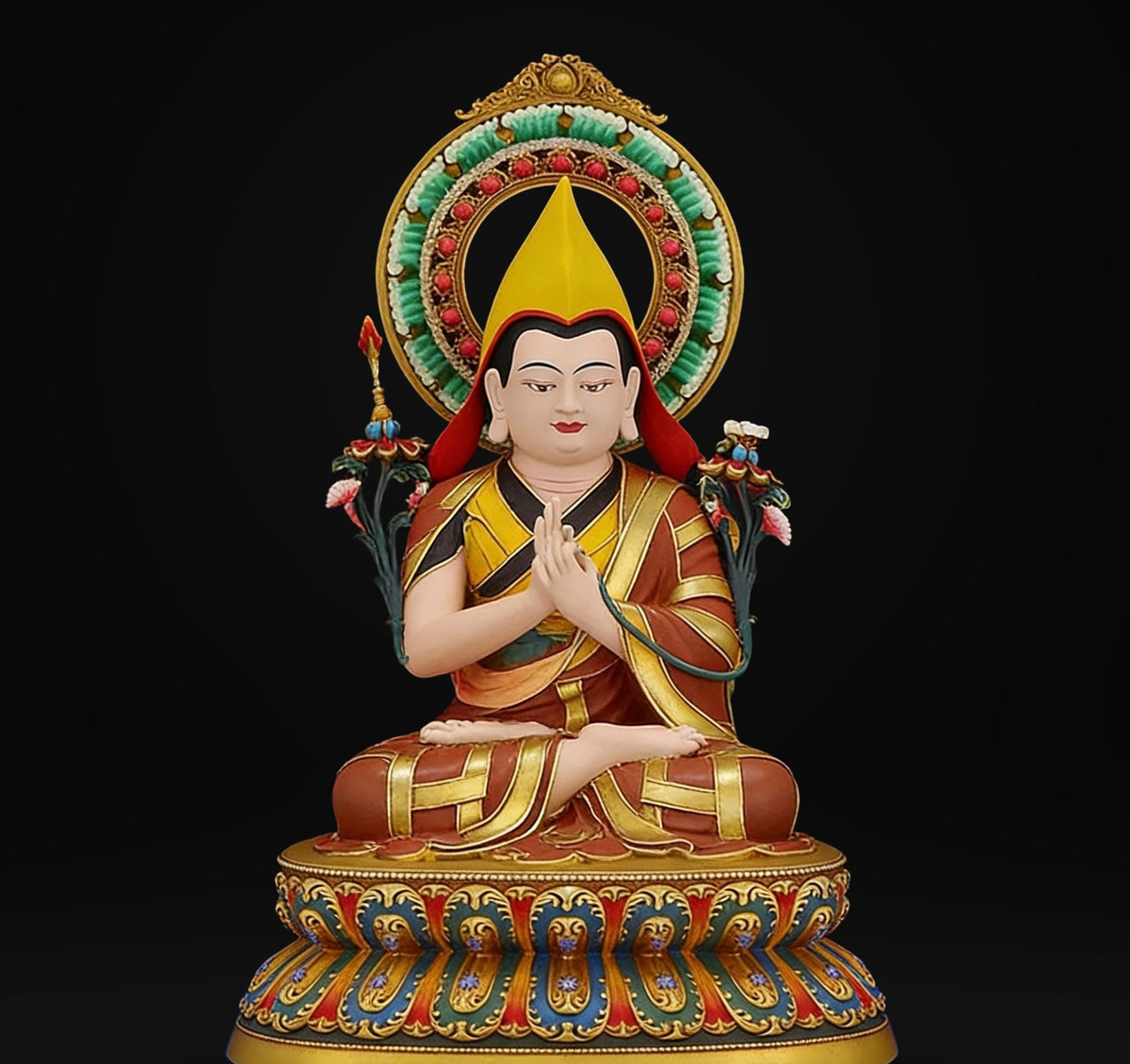
Many Nepali and Tibetan statues are not left as bare metal. Faces are painted in gold, hair in blue, and some figures are coloured all over. If a listing says "hand-painted", "cold gold face" or "polychrome", this guide explains what that means and how to choose between a painted, gilded or plain finish.
Three painted finishes
Painted face (cold gold)
The most traditional touch. After casting and finishing, the face is coated with "cold gold", a fine gold paint applied with a brush rather than fired on, and the eyes, eyebrows and lips are then painted in by hand. The rest of the body may stay as copper or gilt. Our dancing Kurukulla is a good example: a matte copper body with a cold gold face.
Full polychrome
Here the whole figure is painted in colour: robes, jewellery, lotus base and sometimes the halo. Hair is commonly painted deep blue. Polychrome statues look closer to a thangka in three dimensions. Our Manjushri is painted all over and set with turquoise, coral and lapis lazuli.
Painted halo or mandorla
Some statues keep a metal body but come with a separate hand-painted flame halo behind the figure, which is usually detachable.
Related techniques you will see
- Repoussé and hand-chasing: details are hammered and chiselled by hand into the metal before any paint goes on.
- Fire-coloured ("thermal") patina: the metal is heated to produce warm tones, as on our Vajrabhairava.
- Gilding: a gold layer over the whole statue rather than paint. Our statue materials guide explains gilded, brass and copper finishes.
Hand-painted statues in the shop
Nepali copper statues with painted faces, polychrome colour or painted halos. See more in our Buddha Statue collection.


How to choose
Painted, gilded or plain
- Painted face: the classic Himalayan look, with a calm, lifelike expression.
- Full polychrome: vivid and detailed; suits a colourful altar or someone who loves thangkas.
- Gilded: bright and uniform. Our Green Tara comes in both a gilded and a hand-painted style, so you can compare.
- Plain copper or brass: simple, and it develops a natural patina over time.
Size and weight
Check the total height including any halo. Our Green Tara is 15 cm (5.9 in) tall with its back scroll; the Kurukulla comes in 26 cm (10.24 in) and 35 cm (13.78 in) versions; the Manjushri in 27 cm (10.6 in) and 37 cm (14.57 in). Large pieces are heavy: our Vajrabhairava is 54 cm (21.26 in) tall and weighs about 21 kg (46.3 lb), so plan a strong shelf.
Caring for painted statues
- Dust gently with a soft, dry brush. Never use metal polish, water or cleaning sprays on painted areas.
- Handle the statue by the base, not the face or halo.
- Keep it out of direct sun, damp rooms and the direct path of incense smoke, which can dull paint over time.


