

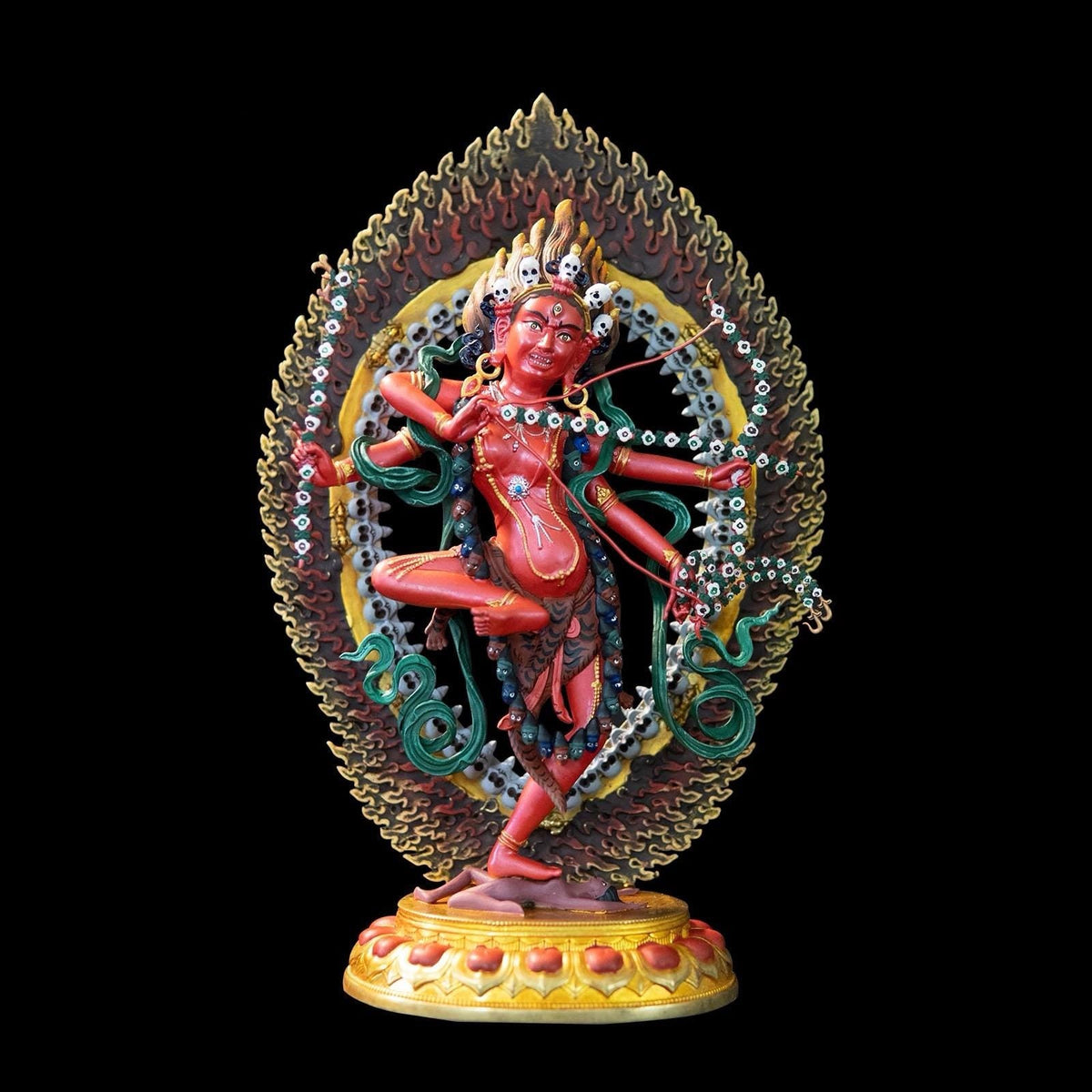
Kurukulle (also written Kurukulla) is one of the most recognisable female figures in Tibetan Buddhist art: red, dancing, and drawing a bow made of flowers. This guide explains how to recognise her, what her attributes are commonly said to mean, and what to look at when choosing a statue.
Who Kurukulle is
In Tibetan Buddhism, Kurukulle is a female deity associated with the activity of “magnetising”: drawing in favourable conditions and bringing situations under a good influence. She is often described as a red form connected with Tara, which is why some listings call her “Red Tara”.
Outside the tradition she is sometimes labelled a “goddess of love”. The more common explanation within it is that her magnetising quality is meant to serve compassion and practice, not personal wishes. Her formal practice is traditionally taken up with a qualified teacher. Many people also keep her image simply as sacred art.
How to recognise her
- Red body. Red is the colour linked with magnetising activity.
- One face, three eyes and four arms in the most common form.
- Flower bow and arrow. One pair of hands draws a bow and arrow made of flowers. This is the detail that sets her apart from every other figure.
- Hook and noose. The other pair of hands usually holds a hook and a noose, often also shown as made of flowers.
- Dancing posture. She stands on one leg with the other raised, usually on a lotus base, often with a halo of flames behind her.
On small statues the bow and arrow are thin and may be simplified, so look closely at the photos before ordering.
Kurukulle statues in our shop
Copper figures in small and large sizes. See the full Kurukulle statue collection.


How to choose a Kurukulle statue
Size
The statues in our collection range from about 12 cm (4.7 in) to about 26 cm (10.2 in) tall. A small figure of around 12 cm (4.7 in) suits a shelf, a desk or a compact altar. A statue of around 26 cm (10.2 in) becomes the centre of an altar and shows the hands, face and implements far more clearly. Measure the height of your shelf first and leave some space above the halo.
Material and finish
Our Kurukulle statues are made of copper, in two kinds of finish:
- Plain copper. The small figure is listed as Tibetan purple copper. The form carries the image; there is no colour to maintain.
- Hand-painted copper. The larger statues are listed as copper with cold gold and mineral pigments, with the face painted in cold gold. These show her red colour and fine facial detail.
Painted and cold gold surfaces are delicate. Dust them with a soft, dry brush and avoid water, polish and rubbing the face.
Details to check
- Face. The expression should be clear and well proportioned.
- Hands and implements. Look for an intact bow, arrow, hook and noose.
- Halo. One of our statues comes with a detachable, hand-painted flame halo. Check what each listing includes.
Where to place the statue
A common custom is to keep a statue in a clean, raised place, at about chest height or higher, and not on the floor or in a bathroom. Keep painted statues out of direct sunlight and away from incense smoke at close range, which can dull the pigments over time.
If you are unsure which figure is right for your home, our guide on how to choose a Buddha statue covers size and material in more detail.


