

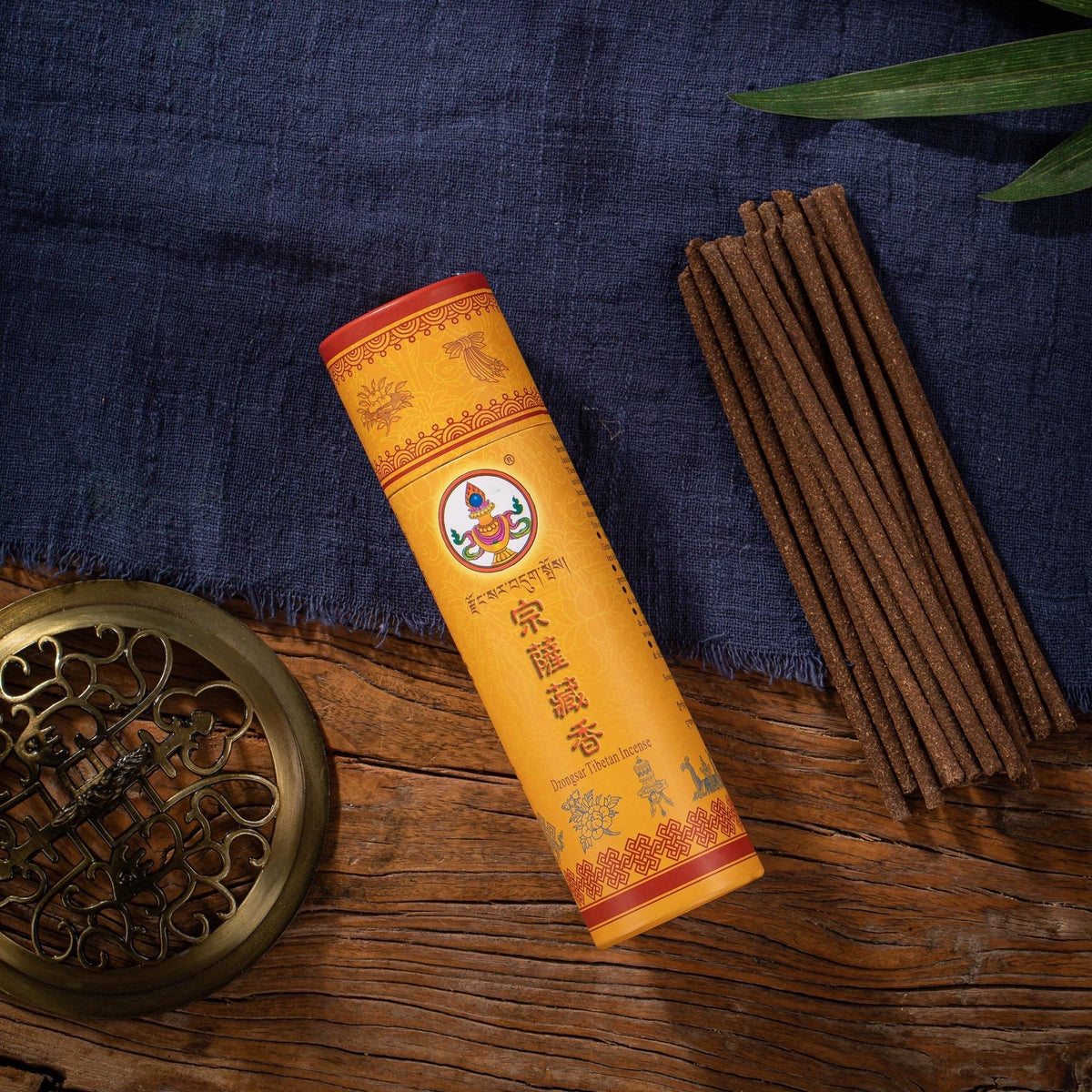
Incense from the Himalayas comes in several shapes. The shape is not only a matter of looks. It changes how the incense is made, how you burn it and how long it lasts.
Tibetan stick incense
Traditional Tibetan sticks have no bamboo core. The whole stick is a pressed blend of ground herbs, woods and resins, so it is thicker than the thin Indian sticks many people know, and it breaks more easily. The scent is usually earthy and herbal instead of sweet or perfumed.
Because there is no core, a Tibetan stick can burn lying flat in a burner box as well as standing in a holder. Recipes are often linked to a monastery or region, which is why sticks are sold under names such as Dzongsar or Katok.
Rope incense
Rope incense is a Nepalese form. Incense powder is rolled inside thin handmade paper and twisted into a short rope. It is light, easy to carry and burns fairly quickly. You light one end and either hang it from a hook or lay it on a bed of ash or sand.
Cones
Cones are the same kind of blend pressed into a small cone. They need no holder with a hole, only a heatproof dish. A cone gives off more smoke in a shorter time than a stick, which suits a short session or a larger room.
Coils
A coil is one long strand wound into a flat spiral. It burns slowly from the outside in and lasts much longer than a stick, so it is chosen when the scent should continue for hours. It rests on a small stand or on ash.
Incense from our collection
Tibetan sticks, Nepalese rope incense and cones. See all incense.


How to choose
- For a daily offering or meditation: Tibetan sticks. One stick, or half of one, is enough for a session.
- For travel or a small altar: rope incense. It packs flat and needs only a dish of sand.
- For a short, stronger scent: cones.
- For several hours: coils.
If you are sensitive to smoke, start with half a stick in a ventilated room and see how the scent suits you before choosing a stronger form.


