

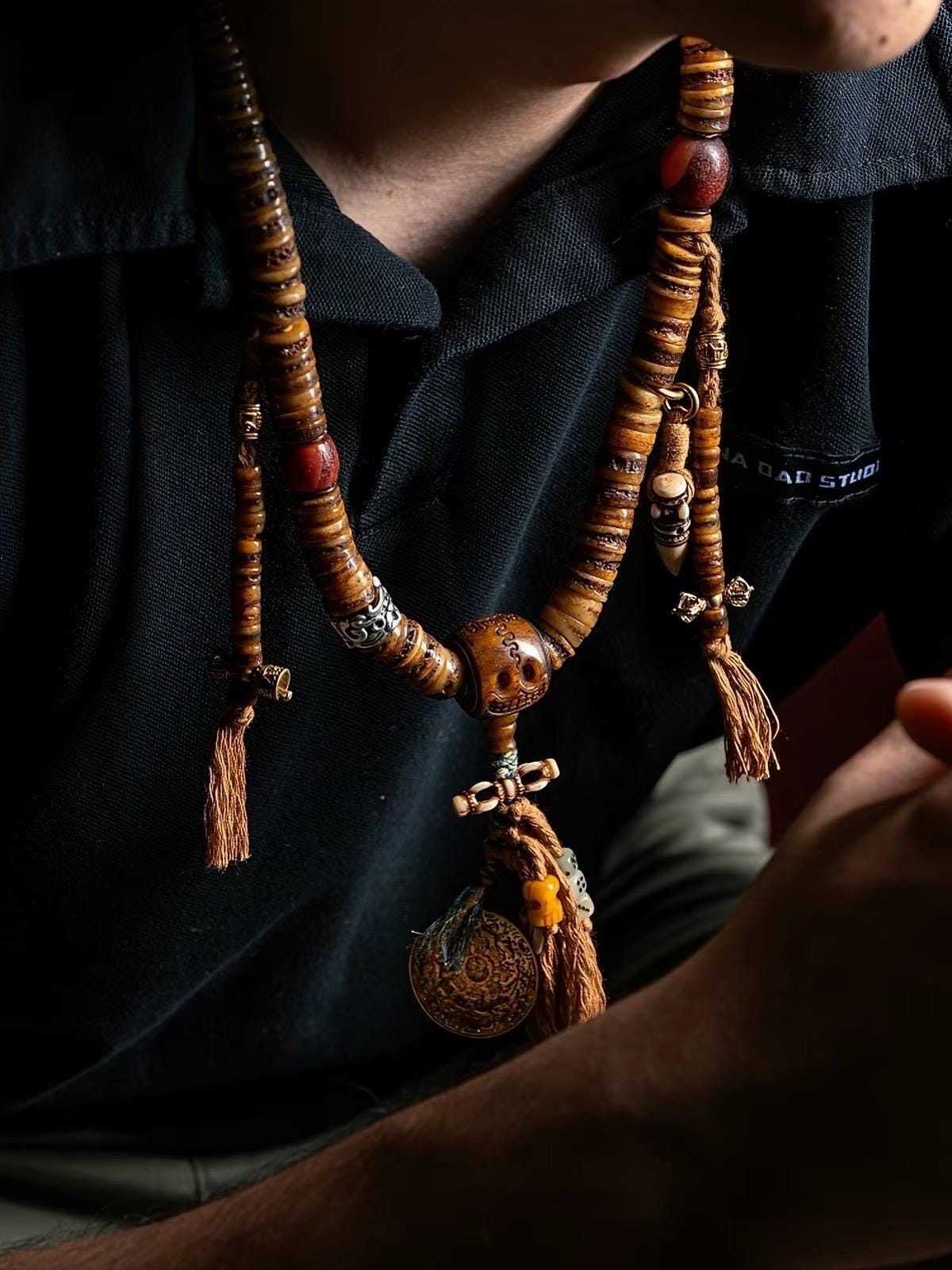
Bone and horn malas are a Himalayan classic. In photos they can look much the same, but the materials differ in colour, weight, surface and how they change with wear. This guide compares the four you are most likely to see.
Why bone malas?
In Tibetan Buddhism, bone malas are commonly explained as a reminder of impermanence, and they are traditionally associated with certain wrathful-deity practices. Many people today also choose them simply for their warm, aged look. The beads are made from animal bone that is cleaned, cut and turned; many are then stained with tea or smoke and hand-carved to look vintage.
The four materials
Yak bone
The most traditional choice. Yak bone is dense and fairly heavy, with an off-white to cream base. It is often carved with lotus, dorje or skull motifs, or stained to an antique brown. Beads range from about 8 mm (0.31 in) for wrist malas up to 12 mm (0.47 in) for necklace malas.
Camel bone
Camel bone is close-grained and takes a smooth polish. It is often dyed or stained to a honey or yellow-brown tone and cut into flat, disc-like beads as well as round ones. It is a little lighter in look than yak bone and shows fewer pores.
Horse bone
Horse bone is usually turned into smaller beads, around 7–8 mm (0.28–0.31 in), and aged to a mellow cream. It suits slimmer wrap bracelets and mixes well with agate and brass accents.
Goat horn
Horn is not bone. It is keratin, the same family of material as hair and nails, so it is lighter, slightly translucent at the edges and often shows dark streaks or a twisted grain. Colours run from grey-black to warm brown. Horn feels warmer in the hand and develops a soft shine with handling.
Bone and horn malas
Yak bone, camel bone and goat horn from our Tibetan Mala collection.


How to choose
- Most traditional: yak bone.
- Smooth, polished look: camel bone.
- Slim wrap bracelet: horse bone at 7–8 mm (0.28–0.31 in).
- Darker, lighter-weight beads: goat horn.
- Size: 8 mm (0.31 in) beads wrap the wrist about four times; 10 mm (0.39 in) about three; 12 mm (0.47 in) is best worn as a necklace. See our mala bead size guide.
Expect natural variation: small cracks, darker spots and uneven staining are normal in bone and horn, and are part of the handmade look. Very bright, perfectly uniform white beads may be resin rather than bone.
Care
Bone and horn do not like water, heat or dryness. Take the mala off before washing, bathing or swimming, and keep it away from radiators and strong sun, which can cause cracks or warping. Wipe it with a soft dry cloth after wear. A very light touch of natural oil on a cloth now and then can help horn keep its shine. Store it in a pouch on its own so harder beads do not scratch it. Read how to care for mala beads for more.


