

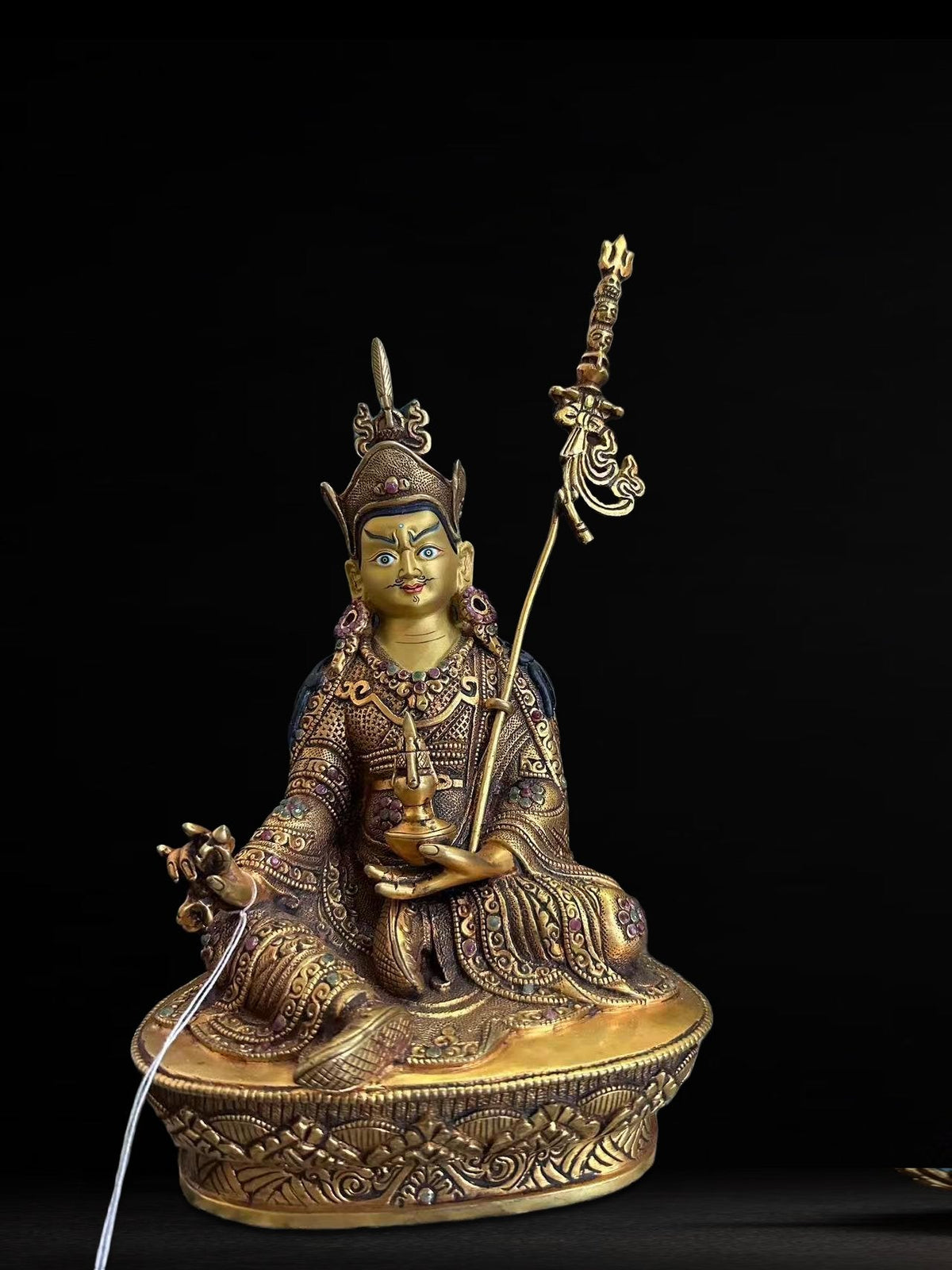
Guru Rinpoche, also known as Padmasambhava, is one of the most widely honoured figures in Tibetan Buddhism. His statue is easy to confuse with others at first, yet a few details make him unmistakable. This guide shows what to look for and how to choose a statue for your space.
Who Guru Rinpoche is
Padmasambhava means “Lotus-Born”; Guru Rinpoche means “Precious Teacher”. Tradition describes him as an eighth-century master from Oddiyana who was invited to Tibet and helped establish Buddhism there, including the first monastery at Samye. In the Nyingma school he is often called a “second Buddha”. His mantra is usually written Om Ah Hum Vajra Guru Padma Siddhi Hum, and the tenth day of each lunar month is traditionally kept as his day.
How to recognise a Guru Rinpoche statue
- The lotus hat. A tall cap with upturned flaps, usually topped with a half-vajra and a feather. No other common altar figure wears it.
- Vajra in the right hand. Held at the knee or raised at the heart.
- Skull cup in the left hand. It rests in the lap and often holds a small long-life vase.
- The khatvanga staff. A trident-topped staff leans in the crook of the left arm.
- Face and dress. Wide-open eyes, a thin moustache and small beard, and layered robes with heavy boots.
Peaceful, standing or wrathful
The seated form above is the most common and the usual choice for a home altar. Standing statues show him with the same vajra, skull cup and staff. Tradition also describes eight manifestations, some of them wrathful: these stand in a ring of flames with a fierce expression. Wrathful forms are commonly explained as compassion acting forcefully against obstacles, not as anger. If you are new to the practice, the seated peaceful form is the simplest place to begin.
Guru Rinpoche statues in our shop
Seated, standing and wrathful forms. See the full Guru Rinpoche collection.


Choosing a size
Guru Rinpoche statues in our shop range from 10 cm (3.9 in) to 54 cm (21.3 in) tall.
- Desk, shelf or travel altar: 10–15 cm (3.9–5.9 in).
- Home altar: 18–25 cm (7–10 in). At this size the hat, vajra and staff are clear from a few steps away.
- Shrine room or centre: 38–54 cm (15–21.3 in). Check the weight and shelf depth; our 54 cm (21.3 in) copper statue weighs about 8.9 kg (19.6 lb) and is 29 cm (11.4 in) deep.
Allow extra height for the hat and feather, and extra width on the left side for the staff. A statue with a halo behind it needs more depth as well.
Material and finish
- Gold-plated copper gives a bright, even surface and is the traditional altar finish.
- Antique-finish brass is darker and quieter, and shows the folds of the robes well.
- Silver-plated white copper has a cool tone that suits a simple, modern shelf.
Our guide to Buddha statue materials and care compares these in more detail.
Placement and care
A common custom is to keep the statue on a clean, raised surface, at chest height or above, and not on the floor. Dust with a soft, dry brush and keep water and metal polish away from plated surfaces. Lift the statue by its base: the staff and the feather on the hat are thin and are the most fragile parts.
Still comparing figures? See how to choose a Buddha statue for your home.


