

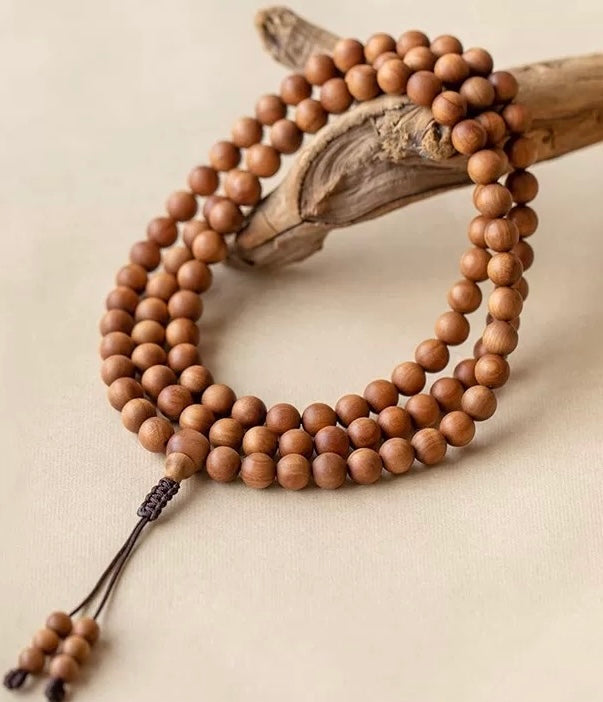
Wooden malas are the most popular choice for daily practice: light, warm in the hand and quiet when you count. Three woods come up again and again: Indian sandalwood, small-leaf red sandalwood and agarwood. Despite the shared name, the two sandalwoods are not related. Here is how to tell all three apart and choose.
Indian sandalwood
Indian sandalwood (Santalum album) is the classic fragrant wood. The beads are pale yellow to light brown, and the soft, creamy scent comes out as they warm in your hand. Old, slow-grown wood is denser and more fragrant. Sandalwood is fairly soft, so the beads pick up small marks and slowly deepen in colour with use.
Choose it if fragrance matters to you and you want a light, calm mala for everyday counting.
Small-leaf red sandalwood
Small-leaf red sandalwood (Pterocarpus santalinus, also sold as red sandalwood or lobular rosewood) is not a true sandalwood. It is very dense and heavy, often sinks in water, and has a deep red-purple colour with a fine grain. It has little scent. With handling it slowly darkens and develops a glossy patina, which many collectors prize.
Choose it if you like a weighty, durable mala that changes colour over the years.
Agarwood
Agarwood comes from Aquilaria trees. When the tree is wounded or infected it produces a dark, fragrant resin, and wood rich in that resin is agarwood. Its scent is deep and complex, and it is also prized for incense. Kalimantan (Borneo) is one well-known source. Because the resin takes years to form, agarwood is usually the most expensive of the three, and the price rises with resin content.
Choose it if you want a richly scented mala and are willing to pay more.
Wooden malas in our shop
One of each wood, all 108 beads. See all Tibetan malas.


Side by side
| Indian sandalwood | Small-leaf red sandalwood | Agarwood | |
|---|---|---|---|
| Colour | Pale yellow to light brown | Deep red to purple-black | Brown to dark brown, often streaked |
| Scent | Soft, sweet, creamy | Faint | Deep, resinous |
| Weight | Light | Heavy, dense | Light to medium; heavier with more resin |
| With age | Darkens slowly | Darkens to a glossy patina | Scent mellows |
| Price | Mid | Mid to high | Highest |
Checking what you buy
- Rub the beads between your hands, then smell them. Real sandalwood and agarwood have a natural scent; a strong perfume smell that fades quickly can mean added fragrance.
- Small-leaf red sandalwood should feel noticeably heavy for its size.
- Look for natural grain. Perfectly even colour with no visible grain may be dyed wood.
- Buy from sellers who name the species, not just "sandalwood".
Care
Keep wooden beads away from water, perfume and lotion, and take them off before washing or exercising. Wipe them with a soft, dry cloth. New red sandalwood may leave a little colour on light fabric. For more, see how to care for mala beads and our mala bead size guide.


